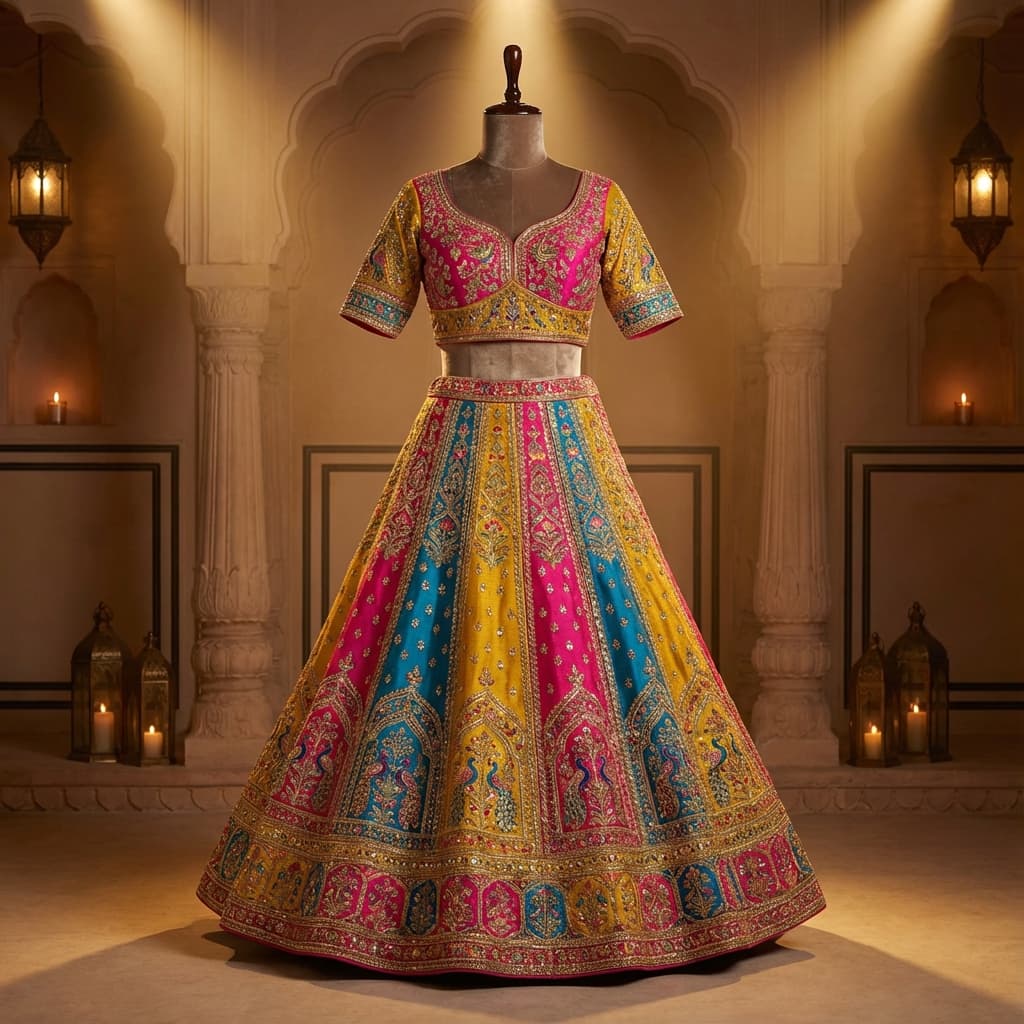
One of the most colorful modern traditions associated with Navratri is quite literally about color.
Each day of Navratri is associated with a different shade, and many women choose to wear that day's color to work, to the temple, for Garba, to visit friends or simply to participate in the festival in a small way.
The practice is especially popular in Maharashtra and Gujarat and has spread much more widely through India and the diaspora.
For 2026, the Navratri color sequence includes a changing palette across the nine days, ending with peacock green for Navami.
But perhaps the loveliest way to approach the tradition is not to treat it as a dress code.
Treat it as an invitation.
Open the wardrobe.
Look again at a saree you haven't worn in some time.
A yellow silk might suddenly become the perfect Navratri saree. A deep green border might inspire another day's choice. Purple, grey, blue and green can each create a completely different festive mood.
And there is no requirement that everything match perfectly.
Tradition has always lived alongside individual taste.
At Shlokam, this is particularly interesting because a saree rarely contains just one color. A teal body may end in a purple pallu. Lime green may meet teal blue zari. Mango yellow may be paired with a contrasting blue.
That interplay of colors is part of what makes Indian textiles so expressive.
So instead of buying something simply because a calendar tells you to wear a certain shade, find a saree whose colors you genuinely love — one you will still want to wear long after Navratri is over.
A festival may give us the occasion. A beautiful saree should outlast it.
Explore the current collection at Shlokam.com.